
The Nonlinear Paradox

Introduction to the AI Paradox Series
This is my second blog post with my thoughts on the state of AI and its implications on the economy, jobs, real estate markets, and life and society in general (first one here). These are my musing and observations, but most importantly just my opinions. To that end, I suspect I will get a number of things “right” and a large number “wrong”; I just cannot tell you when or how to score it. Since I am constantly getting asked about AI or having to hear about it everywhere, I might as well contribute to the discourse, enjoy!
Why Do We Care About Linearity?
First, a personal confession, I have a Ph. D. in Finance with a minor in microeconomics; this required taking some very high-level mathematical economics and statistics coursework. As I learned, I am not good at that level of “math” (trust me… it’s not anything like you might think it is, unless you also have a quantitative degree!). Guess what you call a PhD who was lousy at math but did enough to get by and graduate? Doctor. So here we are!
Disclaimers aside, a lot of the “math” I was doing in the courses related to making the non-linear linear, determining if something was linear, or making “linear approximations” of things we know to be “non-linear”. You see, math (and especially math done by computers…) works great in a “linear space” and this is very useful in statistical analyses and forecasting (something we “economists” do). Ordinary Least Squares regressions (what the cool kids call OLS) is basically shooting a linear straight line through a set of data points and applying some linear math assumptions to test “goodness of it”. (see random examples below from Google Images, which line has a better “fit”?)
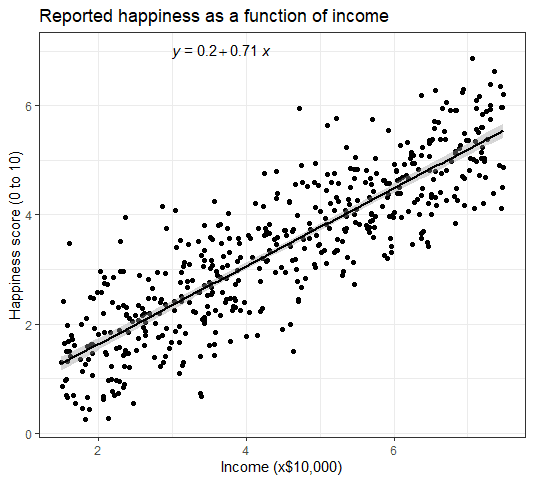
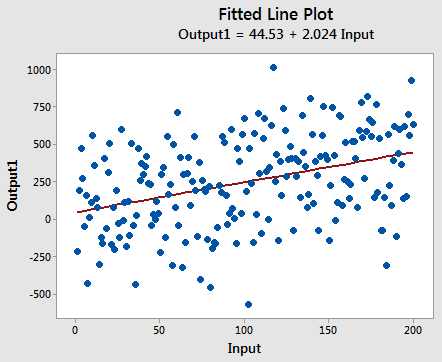
Candidly, the more applied statistical or empirical work you do, the less confidence you have in the soundness of these methods (but alas, I’m not that good at math). So, what I really learned about this, and what you need to know as it relates to the present world discussion on AI predictions is this; linear predictions only work so well as the actual world is linear (i.e. a linear line, aka a “straight line” can predict a linear system, ceteris paribus).
Do Linear Approximations Work for Nonlinear Systems?
I asked this question to many of my professors in the PhD program (all of whom were way better at math than me), it seemed very important as we were being taught to make linear approximations for statistical inference purposes. The answers were something akin to: “well yes, it should, it could, or well, we can’t do much math if we don’t”. I.e., we force the data into the systems, whether it “fits”, that’s for the future to decide! In all fairness, it works way better than you think it would (we reviewed plenty of studies to prove it); nonetheless, there are limitations to these methods, especially when trying to predict the future. Before we talk futurecasting, let’s dive into the topic of nonlinearity!
What Do You Mean, This Is ‘Nonlinear’?
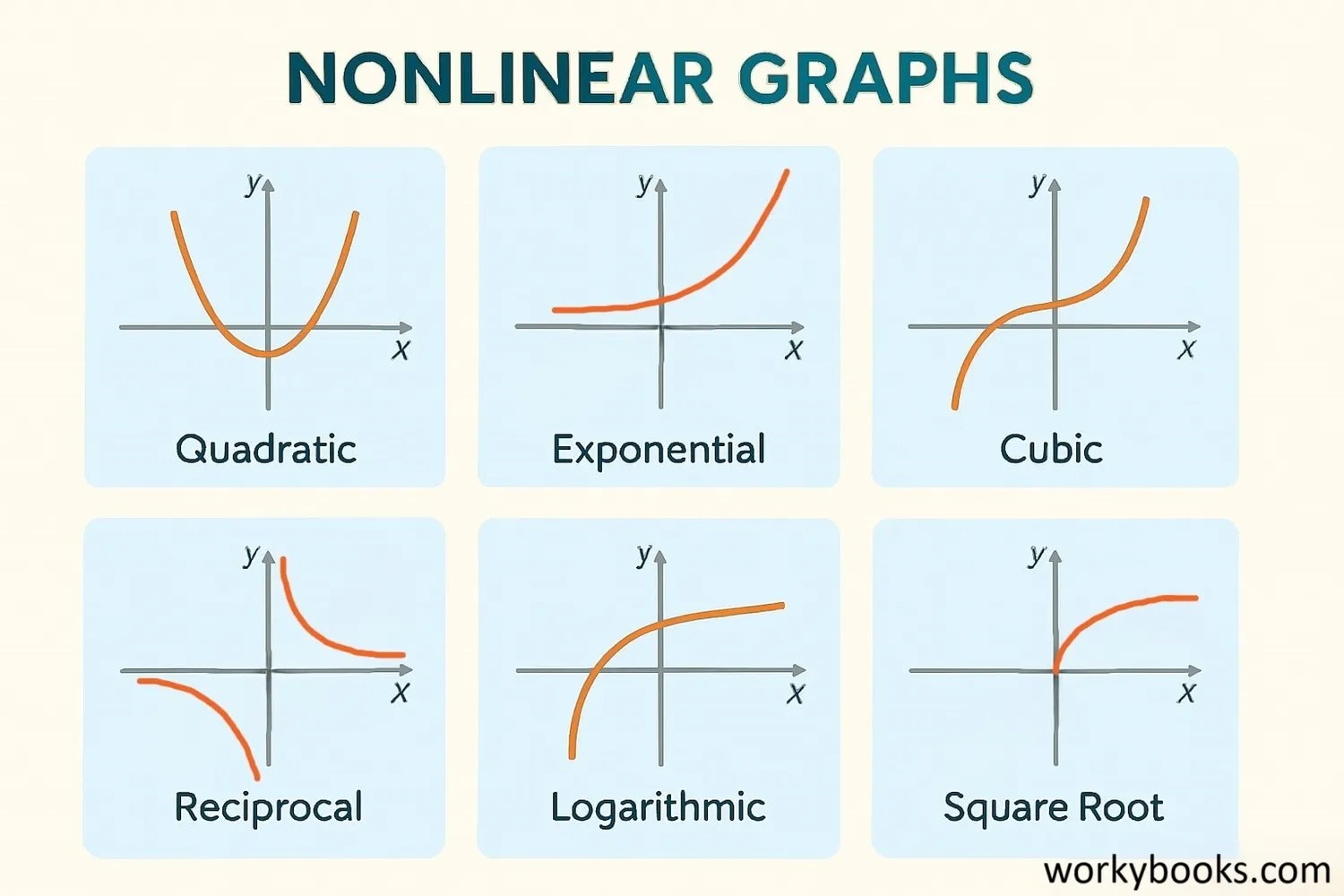
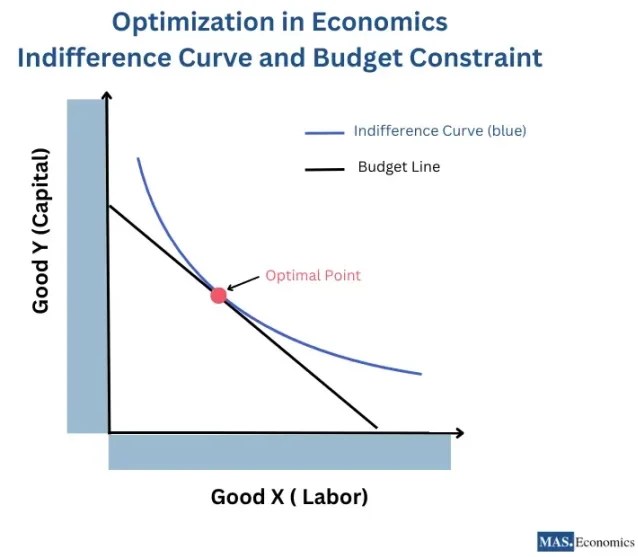
It’s not a straight line, that is it. I have seen the phrase ‘nonlinear’ to mean ‘exponential’ (a particular form of a nonlinear distribution, or curve) or ‘power law’ (a different form, easily confused with exponential curves, especially if you are not good at math…); but it could also refer to any variety of ‘curves’ including ‘s-shaped’, ‘u-shaped’ or even ‘kinked’ lines. All of those are ‘nonlinear’ and some can be more easily ‘linearized’ via ‘transformations’ (like taking the log of the variables, this was a default piece of advice during my PhD program, “hey this doesn’t work” was met with “hmm, have you tried taking the log of it?”). Funny enough, that “log trick” really worked (especially with home prices, go figure). If you found that diatribe on curves and linearity boring, imagine living in that world for a few years during a graduate program!!! (See below, you actually learned all this in high school)
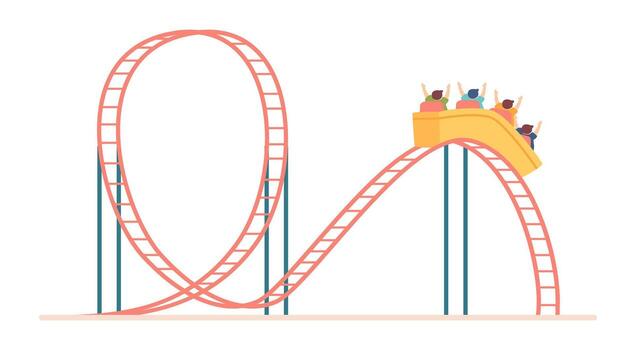
A simpler way to think about ‘nonlinearity’ is to imagine yourself on a roller coaster. Most coasters require you to start with a slow linear climb (this is to build stored energy potential for the ‘curves’ and twists to come, basic physics); if you did a linear projection during this part of the curve, you would assume you would end on the moon. At the top or ‘apex’, you hit a ‘zero’ point on the rate of climb (I cannot express to you in words how important these ‘zero’ points were in the mathematical economics course, like literally it was life’s mission to solve for these, formed the basis of a lot of ‘optimization equations’ which are the basis of a lot of economic theory). At that point, you go nowhere (if linearly projecting of course)! As you know, the next part is the drop, which is linearly the most frightening followed by a sudden turn into something well…. ‘nonlinear’. From there your ability to ‘predict’ the coaster’s path is as good as your foreknowledge of the ride; its path was a work of art, science, and engineering, but not statistical forecasting.
Is the World Linear or Nonlinear?
This is a great debate for theologians, mathematicians, statisticians, poets, and politicians. My own experience, it is quite linear with unique and unpredictable points of nonlinearity. If you experience a lot of surprises in your life, business, or in the world, you are experiencing nonlinearity. If things feel predictable, well, it’s probably due to a linear function. To paraphrase Nassim Taleb, the world (and your life…) is defined by Black Swans; said differently, the nonlinearity is what matters. There is a scarier way to explain nonlinearity… unpredictable. Everything is “predictable” (or forecastable) until it isn’t. How many economic forecasters had global pandemic on their 2020 prediction cards in late 2019? Or major terrorist attack for 2001 in late 2000? Virtually none, yet so many will later claim those events were “predictable” (go figure, this is actually an essential element of a Black Swan per Taleb). That is the fallacy of extrapolating the past into the future; backward looking makes the world look or feel more linear, but at the time, it was quite a nonlinear experience. For the deep thinker, God or the manager of the simulation or other form of ‘higher power’ might be able to make linear sense of our future; but we cannot in real time.
How Does This Relate to AI and the Future?
As I write this, in late 2026, we are increasingly aware of impending potential AI impacts on the economy, jobs, and even everyday life. Thus, we all feel a sense that the future path of humanity will be… nonlinear. We know our linear approximations could easily fail, and this creates heightened senses of fear and anxiety (what you are willingly signing up for when boarding an amusement park ride). Spoiler alert, the future has always been nonlinear, it only feels predictable (aka linear) in the rear-view mirror. Many predictions of impact of AI will be 180 degrees wrong (i.e. not just not happen, but happen in the exact opposite way); personally, I suspect this will be the case for employment (meaning I suspect there will be more jobs, not less as AI adoption accelerates, I’ll explain why in later blog posts).
Of course, some predictions will be spot on, or just 45 to 90 degrees off. Thus, our safe linear world has been disrupted. A perfect example is an attorney who expects to bill out a set number of hours per year for the rest of their legal careers being told their corporate clients expect net billing to be cut 30-40% due to AI system adoption; that could be quite a break in linear income expectations unless they figure out how to “scale” in some nonlinear fashion. Lots of careers are having similar thought processes these days. Fear is a natural reaction to nonlinearity and general unpredictability, but negative outcomes are far from certain (that would actually be a linear extrapolation!).
What Me Worry?
Should you be an optimist or a doomerist about AI? Honestly, I don’t know, my goal is to be a realist (I’ll opine further in future blog posts). That means accepting a lot of uncertainty. Do AI capabilities take off at a “quantum” level and vastly surpass all human ability? Or are they bounded and constrained by “Newtonian physics” or even worse, local politics (as data centers are seemingly more hated than toxic waste dumps)? Expect the unexpected, just realize, when it actually happens…. it might feel… predictable!
Oh a final note…. If you think I poorly explained or were wrong on any of my explanations of the “maths”, you are probably right. You see, I have these amazing things called co-authors and collaborators, so when I do actual statistical forecasting work, I partner with amazing econometricians who actually know the math super well. My big question is, what can we tackle with AI in the coming months and years? I am currently without a linear prediction!

