

Introduction to the AI Paradox Series
This is my second blog post with my thoughts on the state of AI and its implications on the economy, jobs, real estate markets, and life and society in general (first one here). These are my musing and observations, but most importantly just my opinions. To that end, I suspect I will get a number of things “right” and a large number “wrong”; I just cannot tell you when or how to score it. Since I am constantly getting asked about AI or having to hear about it everywhere, I might as well contribute to the discourse, enjoy!
Why Do We Care About Linearity?
First, a personal confession, I have a Ph. D. in Finance with a minor in microeconomics; this required taking some very high-level mathematical economics and statistics coursework. As I learned, I am not good at that level of “math” (trust me… it’s not anything like you might think it is, unless you also have a quantitative degree!). Guess what you call a PhD who was lousy at math but did enough to get by and graduate? Doctor. So here we are!
Disclaimers aside, a lot of the “math” I was doing in the courses related to making the non-linear linear, determining if something was linear, or making “linear approximations” of things we know to be “non-linear”. You see, math (and especially math done by computers…) works great in a “linear space” and this is very useful in statistical analyses and forecasting (something we “economists” do). Ordinary Least Squares regressions (what the cool kids call OLS) is basically shooting a linear straight line through a set of data points and applying some linear math assumptions to test “goodness of it”. (see random examples below from Google Images, which line has a better “fit”?)
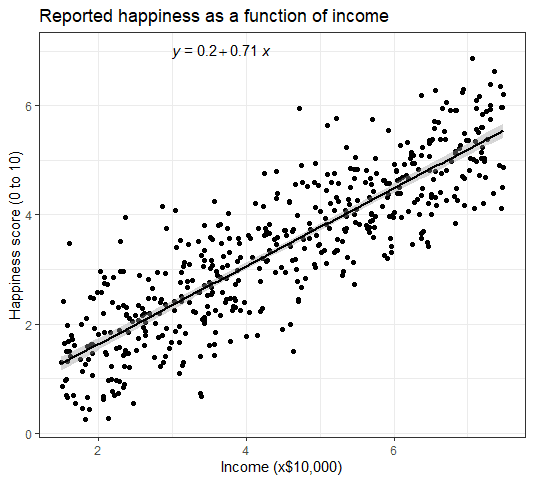
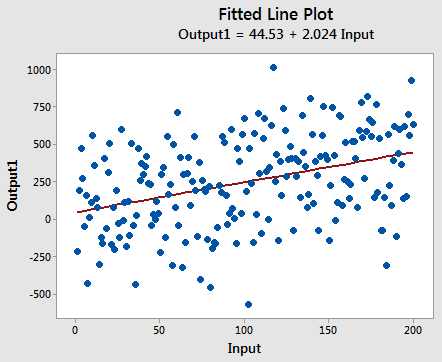
Candidly, the more applied statistical or empirical work you do, the less confidence you have in the soundness of these methods (but alas, I’m not that good at math). So, what I really learned about this, and what you need to know as it relates to the present world discussion on AI predictions is this; linear predictions only work so well as the actual world is linear (i.e. a linear line, aka a “straight line” can predict a linear system, ceteris paribus).
Do Linear Approximations Work for Nonlinear Systems?
I asked this question to many of my professors in the PhD program (all of whom were way better at math than me), it seemed very important as we were being taught to make linear approximations for statistical inference purposes. The answers were something akin to: “well yes, it should, it could, or well, we can’t do much math if we don’t”. I.e., we force the data into the systems, whether it “fits”, that’s for the future to decide! In all fairness, it works way better than you think it would (we reviewed plenty of studies to prove it); nonetheless, there are limitations to these methods, especially when trying to predict the future. Before we talk futurecasting, let’s dive into the topic of nonlinearity!
What Do You Mean, This Is ‘Nonlinear’?
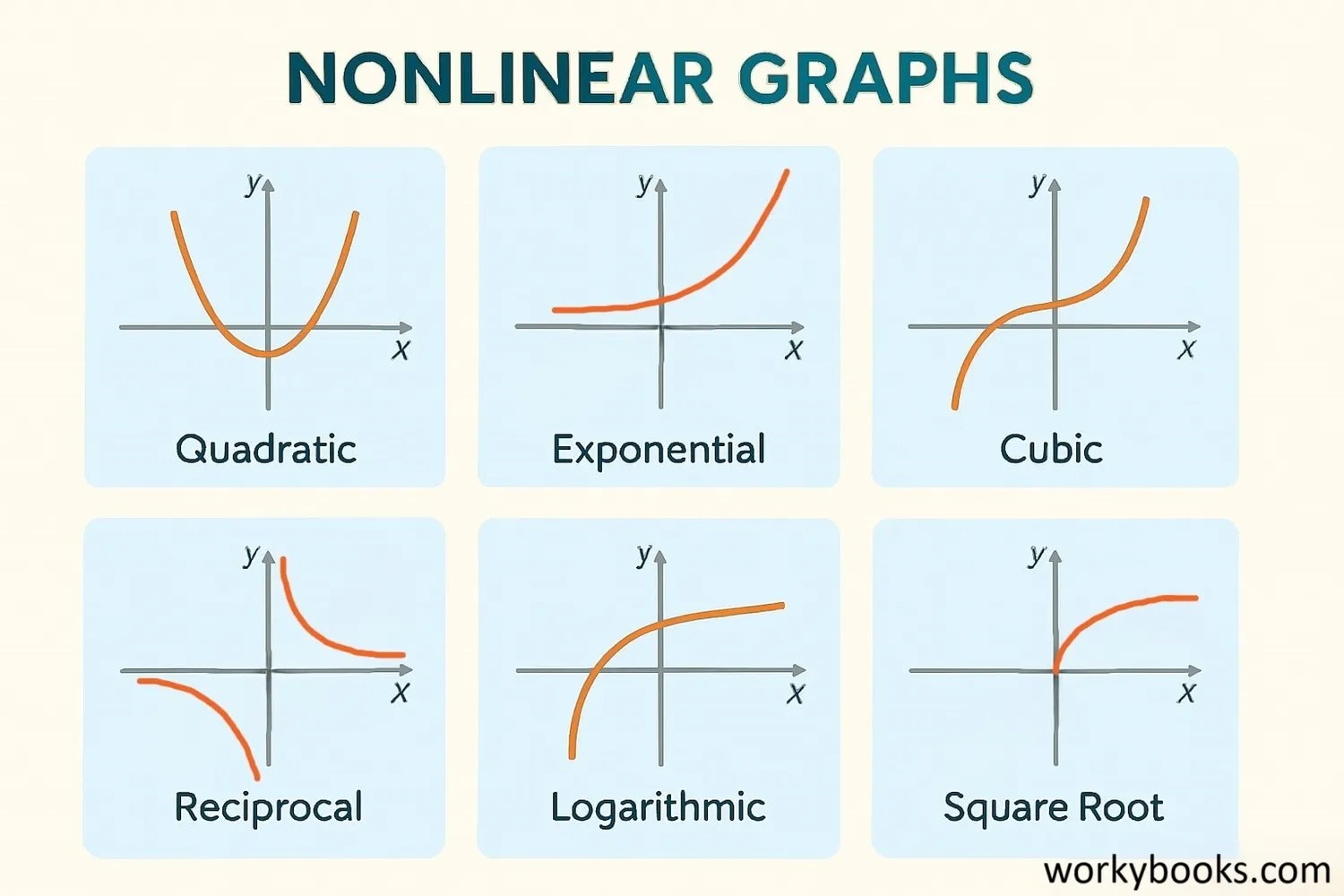
It’s not a straight line, that is it. I have seen the phrase ‘nonlinear’ to mean ‘exponential’ (a particular form of a nonlinear distribution, or curve) or ‘power law’ (a different form, easily confused with exponential curves, especially if you are not good at math…); but it could also refer to any variety of ‘curves’ including ‘s-shaped’, ‘u-shaped’ or even ‘kinked’ lines. All of those are ‘nonlinear’ and some can be more easily ‘linearized’ via ‘transformations’ (like taking the log of the variables, this was a default piece of advice during my PhD program, “hey this doesn’t work” was met with “hmm, have you tried taking the log of it?”). Funny enough, that “log trick” really worked (especially with home prices, go figure). If you found that diatribe on curves and linearity boring, imagine living in that world for a few years during a graduate program!!! (See below, you actually learned all this in high school)
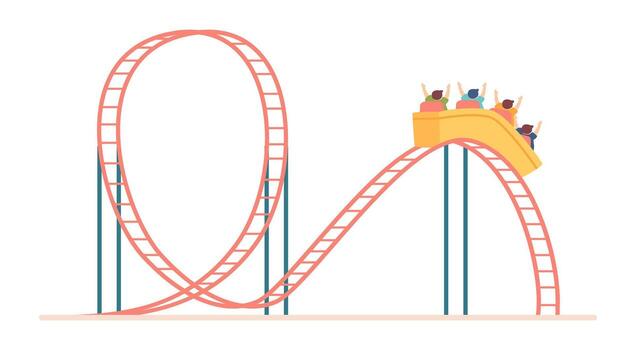
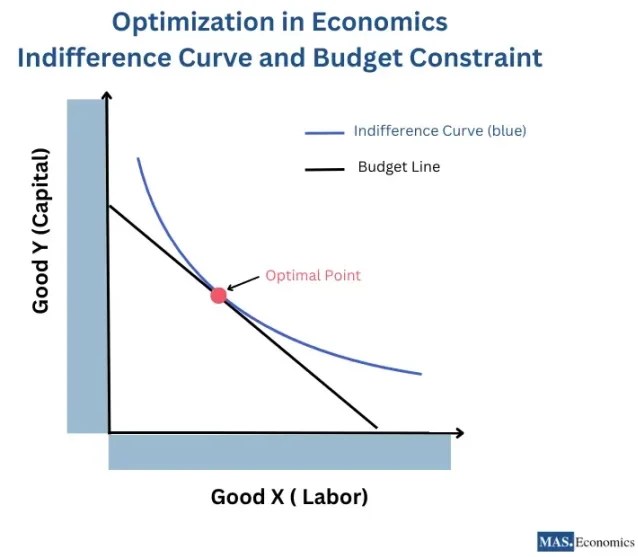
A simpler way to think about ‘nonlinearity’ is to imagine yourself on a roller coaster. Most coasters require you to start with a slow linear climb (this is to build stored energy potential for the ‘curves’ and twists to come, basic physics); if you did a linear projection during this part of the curve, you would assume you would end on the moon. At the top or ‘apex’, you hit a ‘zero’ point on the rate of climb (I cannot express to you in words how important these ‘zero’ points were in the mathematical economics course, like literally it was life’s mission to solve for these, formed the basis of a lot of ‘optimization equations’ which are the basis of a lot of economic theory). At that point, you go nowhere (if linearly projecting of course)! As you know, the next part is the drop, which is linearly the most frightening followed by a sudden turn into something well…. ‘nonlinear’. From there your ability to ‘predict’ the coaster’s path is as good as your foreknowledge of the ride; its path was a work of art, science, and engineering, but not statistical forecasting.
Is the World Linear or Nonlinear?
This is a great debate for theologians, mathematicians, statisticians, poets, and politicians. My own experience, it is quite linear with unique and unpredictable points of nonlinearity. If you experience a lot of surprises in your life, business, or in the world, you are experiencing nonlinearity. If things feel predictable, well, it’s probably due to a linear function. To paraphrase Nassim Taleb, the world (and your life…) is defined by Black Swans; said differently, the nonlinearity is what matters. There is a scarier way to explain nonlinearity… unpredictable. Everything is “predictable” (or forecastable) until it isn’t. How many economic forecasters had global pandemic on their 2020 prediction cards in late 2019? Or major terrorist attack for 2001 in late 2000? Virtually none, yet so many will later claim those events were “predictable” (go figure, this is actually an essential element of a Black Swan per Taleb). That is the fallacy of extrapolating the past into the future; backward looking makes the world look or feel more linear, but at the time, it was quite a nonlinear experience. For the deep thinker, God or the manager of the simulation or other form of ‘higher power’ might be able to make linear sense of our future; but we cannot in real time.
How Does This Relate to AI and the Future?
As I write this, in late 2026, we are increasingly aware of impending potential AI impacts on the economy, jobs, and even everyday life. Thus, we all feel a sense that the future path of humanity will be… nonlinear. We know our linear approximations could easily fail, and this creates heightened senses of fear and anxiety (what you are willingly signing up for when boarding an amusement park ride). Spoiler alert, the future has always been nonlinear, it only feels predictable (aka linear) in the rear-view mirror. Many predictions of impact of AI will be 180 degrees wrong (i.e. not just not happen, but happen in the exact opposite way); personally, I suspect this will be the case for employment (meaning I suspect there will be more jobs, not less as AI adoption accelerates, I’ll explain why in later blog posts).
Of course, some predictions will be spot on, or just 45 to 90 degrees off. Thus, our safe linear world has been disrupted. A perfect example is an attorney who expects to bill out a set number of hours per year for the rest of their legal careers being told their corporate clients expect net billing to be cut 30-40% due to AI system adoption; that could be quite a break in linear income expectations unless they figure out how to “scale” in some nonlinear fashion. Lots of careers are having similar thought processes these days. Fear is a natural reaction to nonlinearity and general unpredictability, but negative outcomes are far from certain (that would actually be a linear extrapolation!).
What Me Worry?
Should you be an optimist or a doomerist about AI? Honestly, I don’t know, my goal is to be a realist (I’ll opine further in future blog posts). That means accepting a lot of uncertainty. Do AI capabilities take off at a “quantum” level and vastly surpass all human ability? Or are they bounded and constrained by “Newtonian physics” or even worse, local politics (as data centers are seemingly more hated than toxic waste dumps)? Expect the unexpected, just realize, when it actually happens…. it might feel… predictable!
Oh a final note…. If you think I poorly explained or were wrong on any of my explanations of the “maths”, you are probably right. You see, I have these amazing things called co-authors and collaborators, so when I do actual statistical forecasting work, I partner with amazing econometricians who actually know the math super well. My big question is, what can we tackle with AI in the coming months and years? I am currently without a linear prediction!

Introduction to the AI Paradox Series
I am setting out to blog my thoughts on the state of AI and its implications on the economy, jobs, real estate markets, and life and society in general. These are my musing and observations, but most importantly just my opinions. To that end, I suspect I will get a number of things “right” and a large number “wrong”; I just cannot tell you when or how to score it. Since I am constantly getting asked about AI or having to hear about it everywhere, I might as well contribute
The Purpose of the Peacock’s Tail
Have you ever seen a male peacock in full display? A bird about the size of a turkey with a set of tail feathers that appears perfectly designed for a Las Vegas dance revue; it is both beautiful and eye catching, yet paradoxically stupid. Can those beautiful tail feathers help this bird find food? Nope. Protect itself from a predator? Nope! What do they actually do? Look beautiful, and that is its purpose, to make the male peacock look attractive to birds of the opposite sex. Before you laugh at this silly adaptation of evolution or odd design of divine orchestration (per each’s own predilections); know that humans do this all the time!

Human Peacocking Is Just as Ridiculous… And Effective
Humans engage in displays of peacocking all the time; it’s a feature of fashion, performance art, and even workplace gimmickry. Yes, we all love a good peacock display, even when we know it was useless and unproductive. Thus, why is it effective? Peacocking is what economists call, a form of signaling. The male species of the colorful bird is displaying their health and vitality, as a sick bird cannot grow and maintain a beautiful display, as such, its presence tells everyone (and most importantly… the lady peahens) that this bird is healthy and strong, and thus a suitable and desirable mate. Humans do this all time to attract romantic partners, sell products, or raise capital (go watch Shark Tank!). In fact, the VH1 show Mystery Method featured a “pickup artist” wearing a top hat and goggles (Google it…) who taught hapless men how to “peacock” to be better at attracting women.

Why Rely on Signals
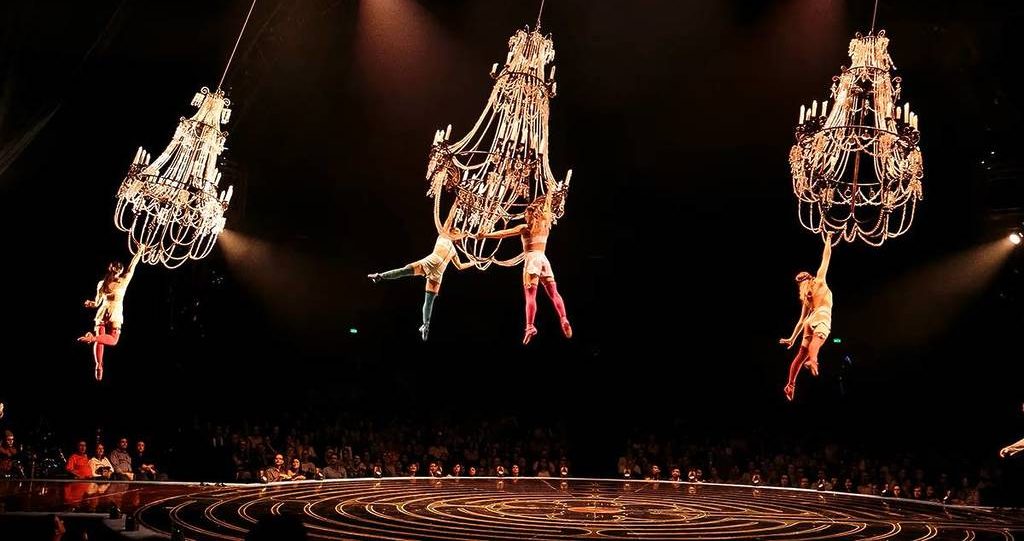
We all have limited time to make decisions, in fact this is one area we share with AI models, a virtual shot clock on token usage (i.e. we sometimes have to pick something, make a decision, or say something in a very limited period of time). Thus, a signal is a useful device to give us information; and the best signals are clear, unambiguous, and most importantly, difficult to fake. Think about the lights and sirens on a police car, they tell you to get over, now. An officer waving his arms out of a random car’s windows while shouting would be far less effective. Our male peacocks on full display and goggle wearing pickup artists are both using the same tactic, gaining attention in a way that is painful and disadvantageous, and thus must be a true signal of awesomeness (I told you it was a paradox!). My favorite example of human peacocking, at least the one I’ve spent the most money to watch, is Cirque Du Soleil; those performers are amazing, but their acts are totally useless beyond keeping me entertained for a few hours. It is because it is difficult to perform those acts that make a ticket valuable and expensive.
Do We Care if a Computer Peacocks?
Ever see someone do long multiplication in their head? Like 354×1032? Impressive right! I can tell you the answer is 365,328 because my iPhone’s calculator app told me so! I’m guessing you are not in the least bit impressed by my calculator skills, nor by the calculator itself. Technology does the impossible, that is literally what gives it value. This plus a million other features of the iPhone made Apple the first trillion-dollar firm. The calculator let more people do math, but didn’t change the value of math, nor the humans doing math. In short, the iPhone is not peacocking, its just functioning as engineered. We value things based on difficulty, rarity, scarcity, and practicality/usefulness; with the first three vastly outweighing the last one. Crazy right? Economists call this the diamonds and water paradox (i.e. which one is both life sustaining and universally free at restaurants?). A woman wearing a huge, expensive diamond ring (at least before the advent of lab grown diamonds….) is signaling, aka peacocking, the value of the mate that chose her as a life partner and thus the value of herself. It’s not the sparkle or the beauty of the diamond… it’s the cost that matters. Am I surprised by the output of AI models and systems today? Yes, but I’m not impressed by the AI output. What impresses me is the long stack of human innovation and discovery that created those models (i.e. without electricity, good luck firing up those GPUs that run Claude). If you have ever seen, read, or watched something to have the reaction of “oh that’s AI” before moving on, you are not impressed either.
The Future of Humanity and Peacocking
Humans still run marathons, but I promise you a beat-up Honda Civic could get you the 26.2 miles in a time substantially faster than the fastest marathoner alive! AI can write blog posts, but you are still reading this one written by a human! Human value is driven by difficulty, rarity, scarcity, and yes…. practicality/usefulness, it always has been. Will AI change this? I highly doubt it, but there are a bunch of sectors of the economy filled with peacocking humans who better figure out that this is what they are doing (as I write this, it is theoretical mathematicians that have been put on notice by the recent release of OpenAI’s math research dump). Does the male peacock know, or care, it’s feather display is functionally useless? Probably not, it helps him land a mate, which is the prime directive of most animals; thus, it functions for him. Thus, if you want to be valuable as a human in a world facing an AI Revolution, you better get your peacock on.
A Warning – Peacocking is Dangerous
I can’t let you go without discussing the dark side of peacocking, the necessary dark side. For an act of peacocking to be meaningful and successful, it MUST be risky! Mystery, the goggle clad pickup artist, risked social mockery; the Cirque du Soleil trapeze artists risk literal death, and I suspect our beautifully feathered friends take similar mortal risk (like getting too big to be able to escape an alligator, my best speculation, go ask an AI if you care). As morbid as it sounds, this fact is why people will spend good money to see a Cirque show live and in-person; the risks are understood (and all too real…). AI could produce a more spectacular visual display of a Cirque style show, no question, but it will remain worthless beyond some cheap views/clicks on social media. The human element makes it worth watching, and I highly doubt an AI can replace that fact in most instances. I suspect this is what will be the ultimate guard rail of humanity, its own fragility. In a famous episode of Star Trek: The Next Generation, the seemingly immortal, God like character Q is stripped of his near-omnipotent powers and banished in mere mortal form to the bridge of the Starship Enterprise; he asks how he can prove he is now human, to which Worf responds… Die. No risk, no return, that is part of human exceptionalism, and I suspect what will keep us grounded in these interesting times!

A Special Note for the Real Estate and Urban Audience – Can a City Peacock?

I am writing this from my home in the City of Winter Park, Florida, a city with a peacock as its logo and unofficial bird/mascot. We have them here, they still run wild around Lake Mizell and surrounding neighborhoods. If you know anything about Winter Park, Florida you know that the peacock is an apt mascot beyond its home to famed bird. Winter Park is one of “those” places, where people go to be seen (especially on our famous Park Avenue high street). Living in Winter Park commands a premium, one that is reflected in real estate prices of all asset classes. Is it functionally better than the surrounding cities/neighborhoods of equal distance to downtown or similar places around Central Florida? Not really, but many wouldn’t want to live anywhere else. How do you know a Central Floridian lives in Winter Park, easy…. They will tell you! It is a form of peacocking! And if see our housing prices and commercial rents, you know it is a costly one!

This is Part 12 of a multipart series, please see past posts for context – Part 1, 2, 3, 4, 5, 6, 7, 8, 9, 10 and 11. Visit JharrisPHD.com for all past articles, biographical information, and photography portfolio.
When Demand for Labor Exceeds Supply
In early 2018, the number of total job openings exceeded the total number of unemployed persons in the United States as measured by the Bureau of Labor Statistics; as of Summer of 2019, this gap as swelled to over 1.625 million more jobs than the total number of seekers. As unemployment sits below 4%, the labor market is exceedingly tight in the United States right now. It is rare for an economy to operate with more job openings than qualified workers, in fact this occurrence has not appeared since before the year 2000. The reality is that many of the firms seeking workers cannot find them, and those who are left unemployed are not qualifying for the open positions. This is a natural result of several forces. First, the persistent growth in the domestic and global economy since the cessation of the Global Financial Crisis; second, the increased specialization of labor given technology; and third, the shifting demographics of an aging workforce. While the economy is still prone to cycles, the second and third trends are likely to persist for decades to come.
Read More
This is Part 11 of a multipart series, please see past posts for context – Part 1, 2, 3, 4, 5, 6, 7,8, 9 and 10. Visit JharrisPHD.com for all past articles, biographical information, and photography portfolio.
The Integral Role of Regulation in the Economy
The United States, as almost all advanced economies, relies on a complex web of regulatory apparatuses to guide and control much of the economy and the daily functions of businesses and personal lives. These regulatory systems are comprised of laws passed by federal and state legislatures, rules and regulations promulgated by government agencies, precedents and orders decided by judicial rulings, and even private self-regulatory groups such as trade associations (often endowed with quasi-governmental power). Thus, if regulatory systems are not functioning well, then it is logical that the economy will function inefficiently, not achieve maximum productivity, and suffer a range of unintended or undesirable consequences. Today, it is beyond obvious that the current regulatory apparatuses are ill-equipped and ill-suited for today’s fast paced, technology laden world; this misalignment will have interesting impacts on the real estate investment and development industries for decades to come.
Read More
This is Part 10 of a multipart series, please see past posts for context – Part 1, 2, 3, 4, 5, 6, 7, 8, and 9. Visit JharrisPHD.com for all past articles, biographical information, and photography portfolio.
Infrastructure and Real Estate Values and Returns
When assessing the value of a site, for any use, there are at least three common factors to consider. First, proximity, what and who is near (sometimes this is called demographics or trade area analysis). Second, accessibility, how can the site be reached via primary and second modes of transit (think walk, drive, train, air, etc.). Third, visibility, how easily can the site the buildings built upon it be seen and recognized by those it hopes to attract as tenants or those tenants’ customers. All are a function of the quality and availability of the infrastructure that serves any given site. Thus, if the infrastructure fails or declines in quality and usability, expect the value and investment potential of the property to do the same. The real estate industry needs to recognize this fact and factor it into investment and development decision going forward as the US is facing greater and greater risks of failing infrastructure.
Read More
This is Part 9 of a multipart series, please see past posts for context – Part 1, 2, 3, 4, 5, 6, 7, and 8. Visit JharrisPHD.com for all past articles, biographical information, and photography portfolio.
Rise of the Global Citizen and Global Traveler
With the proliferation of air travel, moving around the globe has never been easier, or cheaper. In fact, the average price of a domestic ticket in the US has fallen 40 to 50% since the ‘60s and ‘70s in real dollar terms. A natural result of deregulation, increased competition (and the rise of low-cost carries), improved airplane technology, and increased load factors (i.e. a full flight can better cover costs than a partially empty one). The price declines on trans-oceanic travel can be even more dramatic, especially when “sale” fares can make ocean crossings as low as sub-$500 round-trip. The result has been a steady, yet fast climb in the number of people traveling and the distance they travel each year. According to the World Tourism Organization, international arrivals reached 1.33 billion in 2017; this was only approximately 400 million in 1990, meaning global travel rose at over 4.5% annually for at least 27 years. Further, this growth is only expected to move faster and faster for the next ten years and beyond as a natural result of rising middle and upper-middle classes in nearly all parts of the world.
Read More
This is Part 8 of a multipart series, please see past posts for context – Part 1, 2, 3, 4, 5, 6, and 7. Visit JharrisPHD.com for all past articles, biographical information, and photography portfolio.
Who are the Dual-DINKs?
If you study demographics, you are already familiar with the term DINK. For those new to the game it stands for Dual Income-No Kids and refers to households with two effective income earners and no children under the age of 18. The commercial real estate community tracks DINKs as they tend to demand multifamily-rental housing (a commercial asset class) at much greater propensity than their child-laden or single compatriots. As an aside, the two income earners need not be married for this concept (see Part 7 on the growing roommate phenomena). With two incomes and no kids, there is a larger budget for rent as well as for travel (hotel demand) and retail expenditures (especially at food and drinking establishments). When you think about the hip, walkable, mixed-use retail/apartment development you can be guaranteed DINKs will be a good majority of the residents and consumers of the nightlife. But, what people fail to consider, is that there are actually two sets of DINKs, and they have differing but often very similar demands in terms of real estate needs.
Read More
This is Part 7 of a multipart series, please see past posts for context – Part 1, 2, 3, 4, 5 and 6. Visit JharrisPHD.com for all past articles, biographical information, and photography portfolio.
Roommates Rule in Many Rental Housing Markets
Household formation and household composition can be a complicated business. There are so-called “traditional” households with two married adults and a varying number of minor children and then there is the fairly easy to define “single” adult household. The more complex situations are where two or more adults share a living unit but are not legally married; this could be the common situation of an unmarried but otherwise romantically paired couple or it could be the complex arrangement known as “roommates.” Long before Uber, AirBnB, or even the now popular “co-working” office, roommates may have been the earliest human rendition of the “sharing economy.” Roommates typically share rental housing units for the purpose of economy of scale, cost savings, and to have a sense of home-life community. Zillow released a major study in 2017 and found that the share of US adults living as roommates reached 30.0% in 2017, up from 22.1% in 2000. Not surprisingly the rate is higher in high cost markets like NYC, 40.0% in ’17 up from 32.7% in ’00; LA 45.5% up from 37.4%; and Miami 41.0% up from 30.1%. It has also grown in markets with larger shares of younger adults and more transient job bases like Orlando, 35% up from 22.8%.
Read More
This is Part 6 of a multipart series, please see past posts for context – Part 1, 2, 3, 4 and 5. Visit JharrisPHD.com for all past articles, biographical information, and photography portfolio.
Changing the Game in Raising Capital
The 2010s will be remembered for many trends, most fueled by the stark reality of the post-Great Recession recovery. Others will be known from the birth of new technologies and business models. The democratization of finance is perhaps the biggest sleeper story of them all. Historically, raising capital meant asking friends and family to contribute equity, applying for difficult to qualify for loans at national and community banks, and/or draining personal savings and retirement funds while running up balances on high interest rate credit cards. For those with “change the world” ambitions, angel investors and venture capital funds offered access to potentially limitless funds, but the costs were near and complete total loss of control and even ownership. In short, raising capital was risky and very costly. These avenues are still viable options, and are still risky and costly, but they are no longer the only means of accessing vast sources of capital.
Read More
This is Part 5 of a multipart series, please see past posts for context – Part 1, 2, 3 and 4.
Your Neighborhood Warehouse
Amazon announced this month that it will advance its standard “two-day” free shipping plan to a “one-day” shipping plan for Amazon Prime subscribers. While the reduction of a single day may not sound like a lot on a grand scale, it is a major reduction in time the e-commerce giant has to get merchandise to a shopper’s door after a “buy it now” click has been registered. Accomplishing this goal will not be easy or cheap, Forbes reports that Amazon will spend $800 million in Q2 alone as part of this initiative with more spending to come. Why is it so expensive and difficult? Because it means that more and more goods must be pre-positioned near everyone’s’ home if they are to execute this plan in any cost feasible manner. This means we all must have a neighborhood amazon warehouse, and that means a lot of warehouse leasing and construction must take place in the years to come.
Read More
